Join us for an interactive session on creating the conditions for meaningful learning in your work. Over two engaging hours, we’ll explore:
Why learning is essential for navigating uncertainty
How we can learn more effectively together
What you can do to embed learning at the heart of your practice
How do you learn when you’re not sure what you need to learn? Through a blend of practical exercises, social pedagogy insights, and shared reflection, we’ll explore how deep, connected learning can happen when we focus on what truly matters.
This webinar is a taster session for our six-part Leading with Learning programme — designed to help leaders cultivate the motivation and capability to nurture the conditions for learning. 📄 Find full programme details here
✨ Register now to join us live and take the first step in making learning a habit — for yourself, your organisation and beyond.
Please note: as this session is highly interactive and dialogical, it will not be recorded.
Over the 7 webinars, we’ll share valuable insights and practical strategies to enhance relational working. In between each webinar, we’ll also host Community of Practice sessions designed to let you explore how you can further embed relational work in your practice context. All sessions are open to everyone, and you can register for free via the below links.
The webinar series and community of practice sessions are linked to a suite of resources (case studies, background articles, practical tools, etc.) available at https://leavingcare.org/relational-practice-resources/.
We encourage you to share the details with anyone in your network who might be interested and hope to see you online soon!
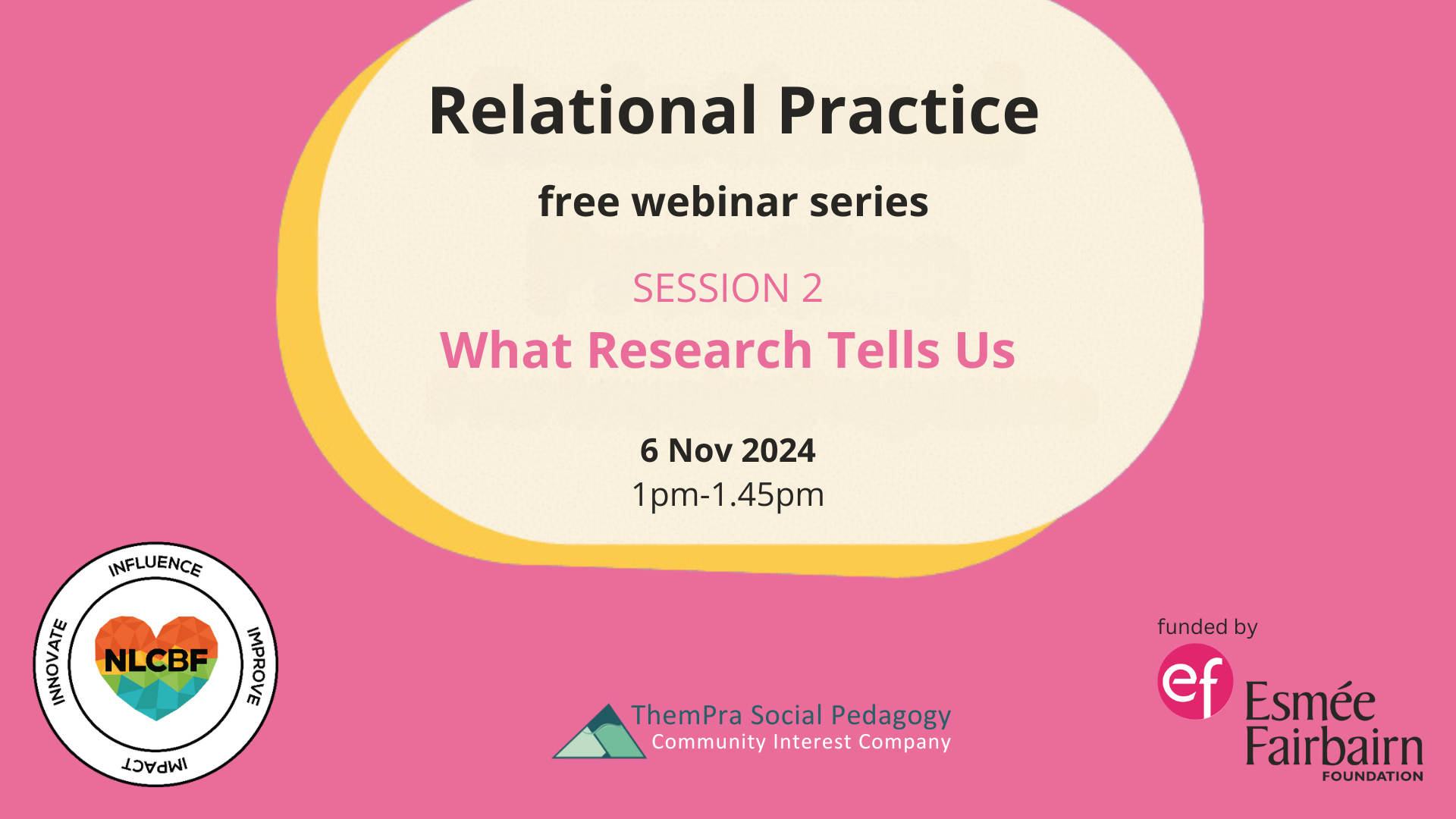
We’re excited to introduce our upcoming free lunchtime webinar series focused on Relational Practice with care experienced young people. This series is designed to share valuable insights and practical strategies to enhance relational working.
Background
Research consistently highlights the importance of relationships in helping young people in and leaving care to thrive. Despite this, implementing relational working practices remains a challenge. To address this, the National Leaving Care Benchmarking Forum, the Esmée Fairbairn Foundation’sLeaving Care Learning Programme and ThemPra ran a peer learning programme throughout 2023-24. This initiative aimed to support local authority leaving care teams and voluntary organisations in developing effective relational practices.
The programme has produced a wealth of learning materials, resources and links, which we will share here over the next few months. To further share these insights, we are hosting a series of webinars this autumn. These sessions are open to everyone, and we encourage you to share the details with anyone who might be interested.
Webinar Schedule
Young People’s Views on Relationships
Date: 23rd October, 1pm-1.45pm
Details: Introduction to the relational working peer learning programme and insights from care experienced young people on relationships.
We’re delighted to invite contributions to our new special issue, guest edited by Prof Arto O Salonen (University of Eastern Finland), Dr Katrin Bain (London Metropolitan University), Gabriel Eichsteller (South East Technological University) & Robyn Kemp (Social Pedagogy Professional Association).
As one of the most urgent crises affecting societies across the globe, the climate emergency requires all human professions to critically consider how they can meaningfully integrate an environmentally conscious perspective in their practice. With climate change disproportionately affecting individuals and communities who are already disadvantaged, we argue that any serious attempts to address social inequality must require approaches that encompass a holistic view of the well-being of the entire planet. This raises the question what an eco-social pedagogy might look like and how it can become a key feature in mainstream discourse and practice. We are inviting authors to publish academic and practice papers as part of a special issue offering contributions that can help develop an eco-social pedagogy.
⏲ Expressions of interest accepted until: 15th July 2024 ⏲ Deadline for draft papers: 31st December 2024
👇 Please find the full call for papers below.
The International Journal of Social Pedagogy is a peer-reviewed, open-access diamond journal (meaning there are no publication charges for authors or fees to read the journal), publishing articles on social pedagogy in the broadest sense.
Social pedagogy is frequently characterised as providing educational solutions to social issues through relationship-centred approaches that further well-being, social inclusion and active citizenship. The impact of climate change is increasingly threatening this ambition in manifold ways, from air and water pollution affecting people’s health to extreme weather events threatening entire communities, disrupting food supplies and causing destitution that force people to seek refuge in other parts of the world.
We argue that the climate emergency has two important implications for the field of social pedagogy – as well as related fields across the human professions:
Social pedagogy must develop a multi-faceted understanding of how it can combat environmental degradation through an eco-social justice perspective, recognising that environmental justice and social justice are intricately linked. It can do so by drawing on explorations in fields such as planetary pedagogy (Salonen et al, 2023), green social work (Dominelli, 2018) and eco-social work (IFSW, 2022), eco-justice pedagogy (Bowers, 2001), ecosystemic wellbeing (Ellyatt, 2022), nature pedagogy and outdoor education, to name just a few. It can also learn from community-based initiatives that might not seem directly connected but draw on shared principles, such as community gardens, city farms and environmental arts.
Climate change is likely to require new forms of social pedagogical support aimed at helping individuals and communities deal with climate-related issues, such as environmental disasters. As a field it can outline meaningful educative ways in which this support can strengthen people’s political agency and engagement as active citizens in environmental issues and other ways to support climate action, including by drawing on the creative arts to explore and highlight the impact of environmental issues and using nature as a medium for our own richer understanding of life aspects, such as interconnectedness, symbiosis, and the complex ways in which we shape – and are shaped by – our environment.
Social pedagogy is focussed on human relationships, and we assert that this should extend to human relationships with nature. We need to understand that the human rights of both present and future generations require our urgent concern with environmental rights and protecting natural resources, ecosystems and biodiversity. Our belief that social pedagogy can make a valuable contribution towards this most critical social issue of our times is echoed by the work of Prof Arto O. Salonen and his colleagues at the University of Eastern Finland, who have outlined a framework for planetary inclusion as part of a forthcoming publication in IJSP. It also builds on the brilliant work by the International Federation of Social Workers in articulating eco-social justice as part of the People’s Charter for an Eco-Social World (2023).
We welcome contributors from social pedagogy, social work, social education and other related human and environmental disciplines to present their research, conceptual contributions and/or practice insights. We particularly invite provocations that enable us to critically reflect on existing discourse and practice, pushing the boundaries of how we understand eco-social justice issues and integrate these into practice. We also welcome policy-level perspectives and learning from work in other practice contexts and from other countries across the world. We encourage authors to integrate or connect their writing to the body of literature on social pedagogy to highlight the relevance of their contribution to the discourse we have been promoting as the International Journal of Social Pedagogy.
Submission to this special issue
Please send early expressions of interest to the IJSP Editorial Office (editors@internationaljournalofsocialpedagogy.com) by July 15th, 2024 in the form of an abstract of 300-500 words, up to six references, and a 50-word biographical statement.
Successful authors will be invited by July 31st, 2024 to submit a full draft for editorial review by December 31st, 2024 through the journals online submission system. Please consult the notes for authors on the journal’s webpage here.
For enquiries about your ideas please email the special issue editors, who will be happy to provide further guidance. The journal is keen to encourage new and existing writers and as such we can offer support in a variety of ways, e.g. for new writers, or for writers who are less confident about writing in English.
Learn how to co-create and co-produce positive change with the people and communities you serve
This course is for you if ...
Designed for anyone working in public service, such as social workers, educators, health professionals, community workers, managers, and leaders, our course will introduce you to the key principles of social pedagogy and Human Learning Systems, and how you can use these approaches to co-create change with the people you support. With a strong emphasis on learning transfer and peer learning, the course enables you to connect your learning straight to your unique practice context and critically reflect within an inspiring peer group on how your co-production practices can have the greatest positive impact. Here are some of the benefits of taking this course:
You will gain a deeper understanding of the key principles of co-production, collaboration, and participation.
You will learn how to apply these principles in your own practice.
You will develop the skills and confidence to co-create meaningful change with the people you support.
You will connect with a community of practitioners who are also committed to co-production.